


Lucky Forge: Idle TD Game
TapNation
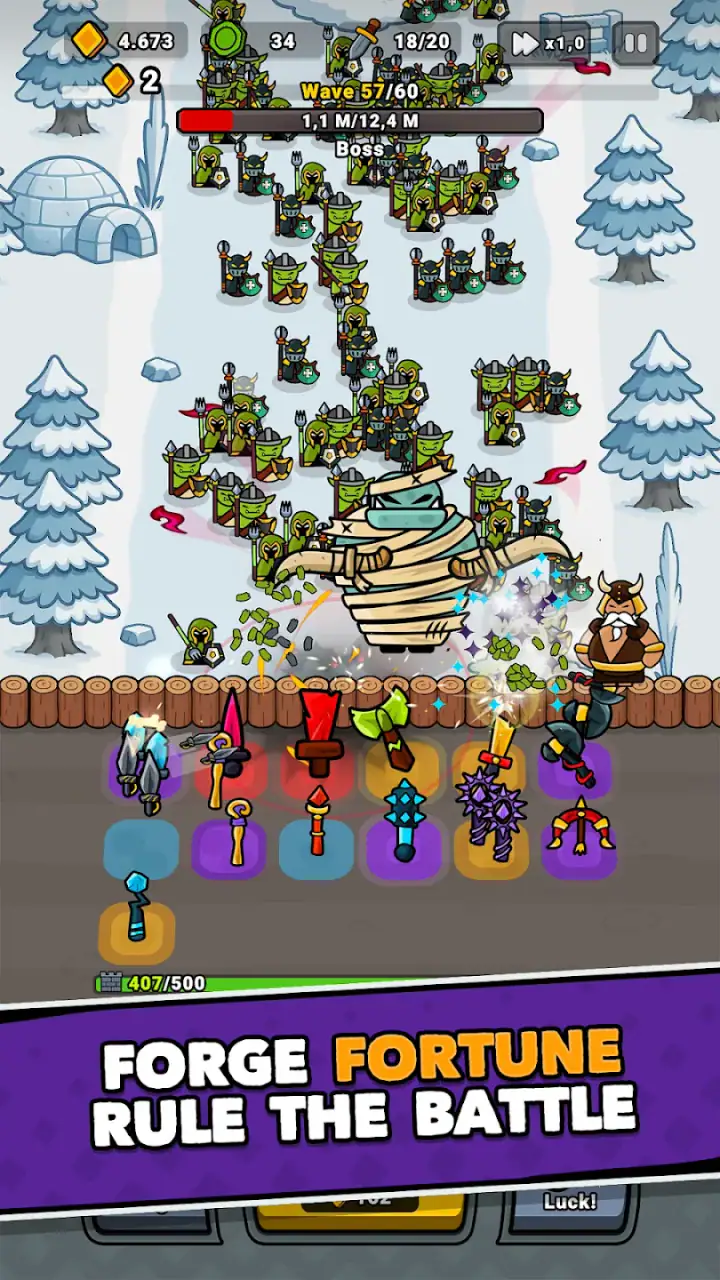
Lucky Forge: Idle TD Game is the kind of strategy game I can understand in a few minutes and still enjoy testing after a longer session. It combines tower defense with RPG progression and a luck-based layer, so every attack is a small balance between preparation and uncertainty. That mix gives the opening a pleasant sense of discovery: I am not only asking whether my defenses are strong enough, but also whether the next improvement will give me the tool I need.
After spending time with it, I see a game aimed at players who like short strategic decisions rather than a heavy, spreadsheet-style tower defense experience. It is free to start, rated for Everyone, and developed by TapNation. The important question, though, is not whether the first sessions are entertaining. They are. The more useful question is whether the loop still deserves attention when the initial surprise disappears. My answer is cautiously positive, with an important condition: you need to enjoy gradual progress and accept that luck sometimes shares control with your planning.
Why the opening week works so well
The first attraction is the way Lucky Forge turns familiar castle defense into something less predictable. In a conventional tower defense game, I usually think in terms of fixed placement, known enemy paths, and carefully calculated upgrades. Here, the RPG and luck elements make each run feel more flexible. A good plan matters, but the result is not entirely determined by the plan, which creates moments where I have to adapt instead of simply repeating a solved layout.
That makes the game approachable for someone who likes strategy but does not want to study a complicated system before playing. The basic fantasy is easy to grasp: build strength, improve the defense, and keep the castle standing. The extra layer comes from deciding how much to trust an uncertain reward or outcome. I found that especially effective during short sessions, because even a brief play period can contain a meaningful choice rather than just passive waiting.
The strongest early habit is to treat luck as a resource to manage, not as a substitute for planning. When a result goes in my favor, it is tempting to assume the same approach will always work. That is where the game can punish careless repetition. I get more from it when I use fortunate outcomes to strengthen a reliable foundation instead of building an entire strategy around one lucky turn.
Related News






The RPG structure also gives the opening a clear sense of direction. Progress feels more understandable when improvements are connected to a broader character or defense journey, rather than being isolated upgrades with no context. I like that this makes a failed attempt feel less empty. Even when a push does not go as planned, the experience encourages me to think about what should change next time: the timing of an improvement, the way I respond to a difficult wave, or whether I am depending too heavily on chance.
For a realistic everyday scenario, imagine having ten minutes before leaving for work or while waiting for an appointment. Lucky Forge fits that gap better than a long-form strategy title that demands a full uninterrupted campaign. I can check progress, make a decision, and stop without needing to remember a huge amount of information. That convenience is one of its real strengths, especially for players who want a strategy game that can be visited in small pieces.
Still, the first week is also when the game benefits most from novelty. New players are naturally curious about how the RPG and tower defense parts interact. The uncertainty makes early decisions feel more important than they may later become. I would not mistake that initial curiosity for proof of endless depth. It is a good beginning, but lasting value depends on whether the progression continues to offer decisions instead of turning into a routine sequence of upgrades.
Gallery
What to learn before spending anything
Because the game is free, it is easy to install it casually and decide later whether it deserves money. That is the approach I recommend. The available in-app purchases range from $0.99 to $114.99 per item, so the gap between a small optional purchase and a very large one is substantial. I would first learn whether the core loop suits me before considering any transaction.
My practical advice is to play through the early excitement without trying to accelerate every obstacle. If a difficult section feels interesting because it asks me to rethink my approach, that is a good sign. If it only feels tolerable when progress is made faster, the game may not be a comfortable long-term fit. This distinction matters more in an idle-oriented strategy game, where patience is part of the intended rhythm.
I also recommend keeping a simple mental note of which decisions actually affect a run. It is easy to click every available improvement because the interface makes progress feel rewarding. A better approach is to pause briefly and ask whether the upgrade solves the problem I am facing now or merely raises a number. That small habit helps separate useful strategy from the pleasant but less meaningful feeling of constant advancement.
Does it keep its value from month to month?
The monthly test is much stricter than the first-week test. Once the basic loop is familiar, Lucky Forge has to provide reasons to return beyond the next upgrade. Its best long-term quality is the combination of predictable development and unpredictable outcomes. I know I am building toward greater strength, but I cannot assume every defensive situation will feel identical. That tension can keep short sessions engaging for players who enjoy adjusting plans.
However, the same design can become less satisfying if the luck component starts to overshadow decisions. Strategy feels rewarding when I can identify why a choice worked or failed. If an outcome seems mostly determined by chance, replaying the same situation may feel less like learning and more like waiting for a favorable result. My enjoyment depends on whether the game gives me enough control to improve through judgment rather than simply persistence.
The idle angle helps with continuity. I do not need to treat every visit as a major gaming session, and that lowers the barrier to returning. A quick check-in can be useful when I want a light strategic distraction instead of a demanding challenge. For me, this is more sustainable than a game that expects daily concentration, but it also means the individual sessions can feel modest. Players seeking dramatic, constantly changing battles may find the pace too gentle.
A helpful way to use it month to month is to give each session a small purpose. I might return to strengthen a weak point, test a different response to a troublesome defense situation, or simply collect progress and make one considered improvement. That approach is better than opening the game automatically and tapping through everything without attention. The game has more staying power when I use it as a compact decision-making break, not as a background obligation.
Its audience size suggests that it has already attracted a meaningful group of players, with over one hundred thousand installs and an average rating of 4.2 from around two thousand six hundred ratings. Those figures make it easier for me to view the game as an established casual strategy option rather than an entirely untested experiment. They do not guarantee that every player will enjoy the same loop, but they indicate that the basic combination of defense, progression, and luck has found an audience.
The review count is around seventy, which is a smaller sample than the overall rating count. I would therefore treat the public reception as a useful signal, not a complete picture of long-term satisfaction. My own judgment is similar: the game has a clear appeal, but the durability of that appeal depends heavily on how comfortable I am with repetition and uncertain outcomes.
Who gets the most from repeated play
I think Lucky Forge works best for someone who likes incremental strategy, enjoys checking progress in short bursts, and does not need every session to deliver a major story moment. It also suits players who enjoy the emotional swing of a lucky result without abandoning all control. The RPG layer gives the defense loop a sense of personal development, while the tower defense foundation keeps the objective easy to understand.
It is less suitable for someone who wants precise competitive balance or complete control over every variable. A player who prefers to solve a level once and then reproduce the exact winning formula may find the luck element irritating. It may also disappoint anyone looking for a large, narrative-driven RPG, because the attraction here is the interaction between progression and defense rather than a deep role-playing story.
Compared with a traditional tower defense game, this one feels lighter and more forgiving in its presentation. I spend less time treating every placement as a permanent mathematical commitment and more time responding to the changing situation. Compared with a pure idle game, it gives me more active thought because the defense and strategy framing keeps my attention involved. That middle position is its identity, but it also means it may not satisfy specialists at either extreme.
The maintenance cost of keeping it installed
One reason I can imagine keeping Lucky Forge on my phone is that it does not demand a large block of time every time I open it. The game is available at no upfront cost, and the age rating of Everyone makes it broadly accessible for households looking for a simple strategy title. Its current version is 1.49.9, and it runs on Android 7.0 or later, so it is not limited to only the newest devices.
Those practical details reduce friction, but they do not remove the need for self-management. An idle progression game can quietly become a habit of checking in without much thought. I try to avoid that by deciding whether I am opening it for a specific strategic reason or merely responding to the notification-like pull of unfinished progress. If the answer is always the second one, the game is taking more attention than it is returning.
The maintenance burden is therefore moderate rather than heavy. I do not need to memorize a complicated campaign to enjoy a short visit, but I do need to accept that progress is gradual. Players who dislike waiting, repeated upgrades, or the feeling of being nudged toward faster advancement may find the free starting point less comfortable over time. The purchase range makes it especially important to set a personal spending boundary before the progression starts feeling slow.
My preferred routine is to make one or two meaningful choices per visit and then leave. That keeps the game from becoming a chore and preserves some curiosity for the next session. I would not recommend turning every available reward into an automatic reason to play. The title is at its best when I use its compact loop intentionally, not when it becomes another stream of routine phone maintenance.
Where fatigue begins
The largest source of fatigue is repetition without a clear change in the decision. Any game built around defense and gradual improvement risks reaching a point where the player knows the broad answer and is simply waiting for enough progress to apply it. Lucky Forge delays that feeling through its luck-based design, but uncertainty alone cannot create lasting depth. If the strategic choices stop evolving, the surprise can turn into frustration.
Another possible pressure point is the relationship between free progression and purchases. I appreciate being able to start without paying, but the listed purchase range means I would stay alert to how the game frames acceleration. Even without buying anything, I want the normal rhythm to feel like a complete way to play rather than a demonstration of what becomes possible after spending. That is a personal standard I apply to any free strategy game.
There is also a difference between useful randomness and random inconvenience. Randomness is enjoyable when it forces me to adapt and gives several responses a chance to work. It is tiring when it makes careful preparation feel irrelevant. My tip is to notice which kind of frustration I am experiencing. If I am annoyed because I chose poorly, I can learn from the attempt. If I am annoyed because my choices barely mattered, I may be reaching the point where the game no longer fits my preferences.
The idle structure can create a quieter form of fatigue as well. Because progress can continue as part of a routine, I might keep returning even after the active decisions have become predictable. That is not a flaw for everyone; some players specifically want a calm progression game. For me, it means I need to periodically ask whether I am still enjoying the defense decisions or only collecting the satisfaction of seeing a progress bar move.
My long-term verdict on the castle defense loop
After the novelty fades, Lucky Forge earns a place as a compact, approachable strategy game rather than as a permanent main game. I like its blend of tower defense, RPG progression, and luck because it gives short sessions enough uncertainty to avoid feeling completely mechanical. The game is easy to recommend to a friend who wants something lighter than a complex strategy title but more involved than a passive idle app.
I would recommend installing it if you enjoy gradual improvement, brief daily sessions, and making decisions under imperfect control. I would also recommend trying it without spending first, then judging whether the normal pace feels satisfying. That test tells me more than the opening rewards do. If the game remains enjoyable when I am not chasing every shortcut, it has a reasonable chance of becoming a durable part of my casual gaming rotation.
I would skip it if you need deep long-term planning, a strong narrative, or complete predictability. I would also move on if repeated outcomes feel like luck is deciding more than I am. In those cases, a more traditional tower defense game may be better because it usually gives clearer control over placement and strategy, while a pure idle title may be better if I want almost no active decision-making.
For my own use, the lasting value comes from moderation. I would keep it installed for occasional castle-defense sessions, especially when I have only a few minutes and want a little strategic tension. I would not make it my only strategy game, and I would not confuse its accessible progression with unlimited depth. Lucky Forge works best as a repeatable small habit, not an all-day commitment.
TapNation has built a free game with a clear personality and a sensible entry point. Its first week is the strongest part because the interaction between planning and luck feels fresh, while its later value depends on whether that uncertainty continues to produce interesting choices. For the right player, that is enough to justify returning. For anyone who wants every outcome to reflect exact preparation, the same feature will eventually be the reason to uninstall.
FAQs for Lucky Forge: Idle TD Game
What is Lucky Forge: Idle TD Game, and how does the gameplay work?
Lucky Forge: Idle TD Game combines tower defense, idle progression, and luck-based upgrades. You build and improve defensive units, place them strategically, and fight waves of enemies that become progressively stronger. When you are not actively playing, the game can continue generating rewards, allowing you to return later, collect resources, upgrade your defenses, and push farther through the campaign.
Can Lucky Forge: Idle TD Game be played offline?
The core tower defense experience may be available without a constant internet connection, which is useful when you are traveling or have limited data. However, some features can require online access, including advertisements, cloud saving, updates, special events, leaderboards, or reward claims. Before relying on offline play, it is worth testing the game without a connection because requirements may change between versions.
Is Lucky Forge: Idle TD Game free to download and play?
Lucky Forge: Idle TD Game is generally offered as a free download, but free access does not necessarily mean that every feature is completely unrestricted. Progress can usually be made through regular play, while optional advertisements, in-app purchases, premium currency, bundles, or time-saving items may be available. Players who prefer a slower, fully free experience should review the store listing and purchase settings before starting.
Does the game require constant attention, or does the idle system handle progression automatically?
The idle system is designed to provide rewards while you are away, so you do not need to watch every battle or remain active continuously. Nevertheless, active play is still valuable because choosing upgrades, improving defensive combinations, claiming bonuses, and responding to difficult enemy waves can accelerate progress. The game is best suited to players who enjoy both short check-in sessions and occasional strategic decisions.
Are there advertisements or in-app purchases in Lucky Forge: Idle TD Game?
Players should expect that a free idle game may include advertising and optional in-app purchases. Advertisements can sometimes provide bonus rewards or speed up progress, while purchases may offer currency, upgrade materials, premium packages, or convenience features. These options are usually not essential for trying the game, but users should check the current Google Play or App Store listing and configure parental or payment controls if needed.
Pros
- Simple idle progression makes it easy to play in short sessions.
- Tower-defense mechanics are accessible for beginners.
- Offline rewards let you make progress while away from the game.
- Multiple upgrade paths add variety to your defensive strategy.
- Lightweight gameplay runs well on many mobile devices.
Cons
- Progress can slow noticeably without frequent upgrades or boosts.
- Random rewards may make some upgrades feel inconsistent.
- Repetitive stages can reduce long-term variety for some players.
- Optional ads may be needed to maximize rewards and speed.
- Limited strategic depth may disappoint experienced tower-defense fans.


